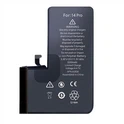
Winter is here, and the phone's power has turned on its metaphysical mode.
I believe everyone has encountered the following situations more or less.
Why does my little phone clearly show that there is still 20% battery, but I take it out to scan a shared bicycle, and then it displays 2% battery, and then it automatically shuts down, leaving messy and rustling in the north wind Shaking me.
Why is my little mobile phone turned into a brick when it freezes outdoors, but when I return to the room to warm it up, it can turn on again and the battery level is restored.
Or why my little mobile phone drops so fast in winter, so I have to carry a power bank wherever I go.
Then you may wonder about life: Is my mobile phone battery broken, why is it as unpredictable as a child's temper?
In fact, your mobile phone battery is not broken, it is born with this temper, and can only follow it.
First of all, you have to know that the cell phone contains a lithium-ion battery. Yes, it is the lithium-ion battery that won the Nobel Prize in Chemistry this year.
Lithium-ion batteries are mainly composed of cathode (Cathode Electrode), anode (Anode Electrode), electrolyte (Electrolyte), separator (Separator), and case (Case).
Because the space inside the mobile phone is small, in order to make full use of the space, the positive electrode of the lithium-ion battery on the mobile phone is lithium cobalt oxide (high compaction density, smaller volume, and less space), and the negative electrode is graphite. I believe that everyone has a better understanding of the principle of lithium-ion batteries, which is to store and release energy by relying on the migration of lithium ions between the positive electrode and the negative electrode. The migration behavior of lithium ions resembles a rocking chair, and is also called a "rocking chair battery". When charging, lithium ions are extracted from the positive electrode, and then inserted into the graphite layer of the negative electrode through the electrolyte, where they are combined with electrons from the external circuit; and when discharging, the direction of movement of lithium ions and electrons is opposite to that of charging. The above picture is only for the convenience of explaining the principle of lithium-ion batteries, and only draws the movement of lithium-ion batteries so simple. In fact, the movement of lithium-ion batteries is much more complicated than this, just look at the picture below.
During discharge, lithium ions move from the negative electrode to the positive electrode. They must first diffuse in the graphite layer, pass through the graphite and electrolyte interface, then migrate in the electrolyte, pass through the electrolyte and lithium cobalt oxide interface, and finally in the lithium cobalt oxide. In the spread. This step by step can really be said to cross the mountains and the sea, and it is really not easy for lithium ion to "move home once".
Having said that, why does the lithium-ion battery power drop so quickly in winter?
When you get a picture, the first thing to look at is its coordinate axis. The abscissa is the capacity Q (electricity), and the ordinate is the voltage U. Seeing this, I can’t help but think of a formula: W=QU (energy=electricity× Voltage)
With a little knowledge of calculus, we can know that the area enclosed by the curve and the coordinate axis in the figure is energy. This picture tells us that as the temperature of a lithium-ion battery decreases, the energy it can release is decreasing. Not only that, its capacity is decreasing, and its voltage is also getting lower.
This is why lithium-ion batteries are not durable in winter. The curious little cutie is definitely not satisfied with just knowing this phenomenon, but wants to know the deep-seated reasons.
As mentioned earlier, when a lithium-ion battery is discharged, lithium ions migrate from graphite to the positive electrode, crossing the mountains and the sea. When the temperature of a lithium-ion battery decreases, the migration of lithium ions will be more difficult. When the temperature decreases, the diffusion coefficient of lithium ions in graphite and lithium cobalt oxide will decrease, and the viscosity of the electrolyte will increase, and the migration of lithium ions in the active material and the electrolyte will be greatly hindered.
This sounds unintuitive. Let's take a look at the composition of no added electrolyte to know what's going on. The solvent of the electrolyte is a mixture of ethylene carbonate (EC) and dimethyl carbonate (DMC).
Ethylene Carbonate, melting point: 34~37℃
Dimethyl Carbonate, melting point: 2~4℃
Do you see the melting points of these two substances? Ethylene carbonate solidifies at room temperature, and dimethyl carbonate becomes a solid at 0°C. Then when the lithium-ion battery is in a low temperature environment, the viscosity of the electrolyte will increase, and in severe cases, it will even partially solidify. Lithium ions migrate in the frozen electrolyte, which is very difficult to think about.
At low temperatures, the migration of lithium ions is hindered. The most significant impact is that the internal resistance of the battery will greatly increase, and the terminal voltage of the lithium-ion battery (terminal voltage = open circuit voltage-current x battery internal resistance) drops. When the mobile phone detects lithium ions When the battery is at a low voltage, it will warn you that the battery is low when thinking that the battery is almost dead, and even automatically shut down to protect the battery. In fact, the lithium-ion battery obviously has so much power, but it just can't show it.
In order to overcome this problem, scientists are also working hard to develop electrolyte additives and low-temperature electrolytes so that lithium-ion batteries can be used normally at low temperatures.
For the lithium-ion battery on the mobile phone, is there a way to prevent it from losing power so quickly in winter?
Of course, there is a way. You don't use your mobile phone in the cold outdoors. Find a warm place, such as in a heated room, and keep your small mobile phone without being ill-tempered. By the way, isn’t it good to play with a mobile phone in a heating room? If you really want to use your mobile phone outdoors in the cold, use it as soon as possible, and put it in your pocket as soon as you use it. Don’t worry if your phone is frozen and stupid. Put it in a warm place and it can recover and be used normally.
In fact, in winter, you should pay more attention not to charge your mobile phone in low temperature. As mentioned earlier, the migration rate of lithium ions at low temperatures will decrease. When charging lithium-ion batteries at low temperatures, the rate of lithium ions being inserted into the graphite layer is relatively slow, and there will be no time for lithium ions to be inserted into the graphite layer, but directly Electrons are obtained on the graphite surface to form metallic lithium. This process is called "lithium precipitation". Part of the precipitated metallic lithium becomes inactive, that is, it will not participate in the future lithium ion migration and becomes "dead lithium".
Smart, you must have thought that when there are less lithium ions involved in the migration during charging and discharging, the capacity of the lithium ion battery will also be reduced. This capacity degradation is irreversible, even if you take the battery back to a warm place. , It can't be restored. At this time, there are only two solutions-changing the battery or changing the phone (there is one more reason to change the phone).